

For RV enthusiasts, reliable power isn’t a luxury—it’s the foundation of freedom. The ability to run appliances, charge devices, and illuminate your space off-grid defines the quality of your adventure. Traditional gas generators are noisy, require fuel, and are often prohibited in campgrounds. Battery-based solutions offer a cleaner alternative, but not all are created equal. Your choice in a portable power station directly impacts your trip’s comfort, duration, and environmental footprint.
This is where a dedicated investment in a high-quality system pays dividends. We’ll explore the concrete advantages of modern portable power, focusing on why OUPES portable power solutions are engineered to meet the rigorous demands of RV life. From silent operation to rapid recharging, the right power station transforms how you travel.
Unmatched Power Reliability and Capacity
The primary reason to upgrade your RV’s power system is to eliminate uncertainty. A flickering light or a dead fridge can turn a serene getaway into a stressful situation. Modern portable power stations provide stable, clean sine wave output, which is crucial for sensitive electronics like laptops, CPAP machines, and high-end coffee makers. This ensures your gear operates safely and efficiently, without risk of damage from power surges or dirty electricity.
Capacity is measured in watt-hours (Wh), which dictates how long you can run your devices. For RV use, a station with at least 1000Wh is a practical starting point for weekend trips, powering lights, a small fridge, and charging stations. For extended boondocking or powering high-wattage appliances like microwaves or induction cooktops, capacities of 2000Wh and above become essential. Investing in sufficient capacity from the outset prevents the need for a costly secondary upgrade later.
The Importance of Expandable Systems
A key feature in advanced power stations is expandability. Some models allow you to connect additional external battery packs, effectively doubling or tripling your total energy storage. This modular approach is a smart financial decision. You can start with a core unit and expand your capacity as your needs—or trip lengths—grow, without replacing the entire system. This future-proofs your investment against evolving power requirements.
Silent, Fume-Free Operation Anywhere
The decibel level of a traditional generator isn’t just an annoyance; it can violate campground quiet hours and disrupt the natural ambiance you sought by escaping to the outdoors. Portable power stations operate at near-silent levels, typically under 45 decibars—quieter than a normal conversation. This means you can run power overnight for medical devices or to keep your refrigerator cold without disturbing your neighbors or your own peace.
Equally important is the complete absence of exhaust fumes. Gas generators emit carbon monoxide, requiring strict outdoor placement away from vents and windows. A portable lithium battery station produces zero emissions, allowing you to safely store and use it inside your RV. This enhances safety, simplifies setup, and grants you access to campgrounds and national parks that have strict “no generator” policies, vastly expanding your potential destinations.
Rapid Recharging and Versatile Input Options
A power station is only as good as its ability to get back to 100%. Long recharge times can strand you for a day or more, tethered to a single outlet. Leading systems now offer multi-input charging, combining AC wall outlets, 12V car sockets, and solar panels. The most significant advancement is in fast-charging technology via AC. Some high-capacity stations can recharge from 0% to 80% in well under two hours, minimizing downtime during a quick lunch stop.
Solar charging is the ultimate tool for energy independence. By pairing your station with compatible solar panels, you can harvest free energy from the sun, creating a self-sustaining power cycle. For prolonged off-grid stays, this capability isn’t just convenient—it’s transformative. It turns sunlight into a reliable fuel source, reducing or eliminating the need to seek shore power. When evaluating stations, consider the maximum solar input wattage; a higher rating means you can connect more panels for faster solar recharging.
Durability and Integrated Safety for Mobile Use
An RV power solution must withstand the rigors of travel—vibration, temperature fluctuations, and occasional bumps. Investment-grade power stations are built with robust housings, often using impact-resistant materials. More critically, they incorporate advanced Battery Management Systems (BMS) that continuously monitor for issues like over-voltage, over-current, short-circuiting, and temperature extremes. The BMS automatically intervenes to protect both the battery cells and your connected devices.
Thermal management is another crucial factor. Passive cooling (simple vents) can suffice for lower-output models, but high-wattage units often feature quiet, intelligent fan systems that activate only when needed to dissipate heat during heavy use or fast charging. This precise thermal control prolongs the battery’s lifespan, ensuring your investment delivers reliable performance for years. A station designed for adventure won’t fail when you need it most.
High-Power Output for Demanding Appliances
Many RVers want to bring the comforts of home on the road. This means running appliances that demand high surge and running watts, such as electric kettles (1500W), hair dryers (1800W), or even small air conditioners (1000-1500W). The continuous and surge power ratings of your portable station determine what you can actually use. A unit with a 2000W continuous output and a 4000W surge rating can handle these demanding loads, while a 500W unit cannot.
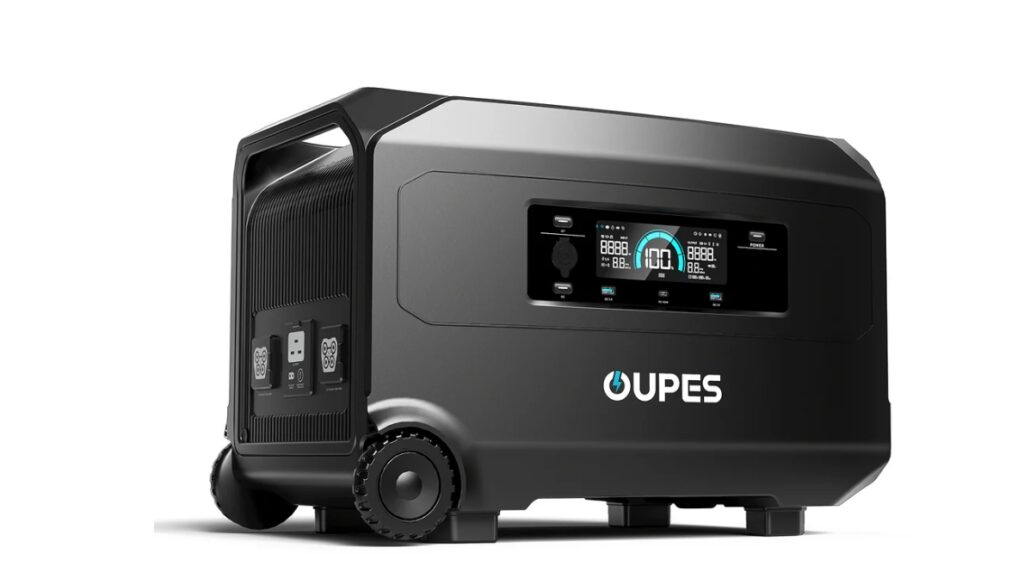
This capability consolidates your power needs. Instead of a separate generator for the AC and a small battery for lights, a single high-output station like the OUPES Guardian 6000 V2 can manage everything. It simplifies your setup, reduces the gear you need to carry, and provides a centralized view of your power status. When investing, honestly assess the total wattage of the devices you wish to run simultaneously to ensure your chosen model has the necessary headroom.
Frequently Asked Questions
How long can an OUPES power station run my RV refrigerator?
It depends on the refrigerator’s wattage and the station’s capacity. A typical 12V RV compressor fridge uses about 60-80 watts when running. A 1000Wh OUPES station could theoretically run it for 12-16 hours, accounting for compressor cycles. For a 3-way absorption fridge, which uses 150-300 watts, runtime would be significantly shorter. Always check your appliance’s specific power draw and calculate based on the station’s watt-hour rating.
Can I use a portable power station while it’s charging?
Yes, most high-quality portable power stations support pass-through charging. This means you can plug the station into a wall outlet, solar panels, or your car while simultaneously powering devices from its outputs. This is incredibly useful for maintaining power during a quick recharge stop. However, consult your specific model’s manual, as using pass-through charging during very high-load scenarios may slightly reduce overall charging efficiency.
Are these power stations safe to use in hot or cold weather?
Lithium batteries perform best within a defined temperature range, typically between 32°F and 104°F (0°C to 40°C) for operation and a narrower band for optimal charging. A built-in BMS will halt operation if temperatures exceed safe limits to protect the battery. For use in extreme climates, it’s advisable to store and charge the unit within your temperature-controlled RV and avoid leaving it in direct, hot sunlight for extended periods.
What is the typical lifespan of an OUPES portable power station?
The lifespan is measured in charge cycles. A charge cycle is one full discharge and recharge. Quality lithium iron phosphate (LiFePO4) batteries, used in many models, are rated for 3,000 to 5,000 cycles before capacity reduces to around 80% of its original. With regular use, this translates to a decade or more of reliable service. Proper care, such as avoiding complete 0% discharges and extreme temperatures, will maximize longevity.
Do I need a special inverter for my RV’s air conditioner?
Not necessarily. The portable power station itself contains a pure sine wave inverter. The critical factor is whether the station’s continuous and surge wattage ratings exceed the air conditioner’s requirements. Start by checking your AC’s starting wattage (surge), which can be 2-3 times its running wattage. You must select a power station whose surge rating surpasses that initial spike to successfully start and then run the unit.
Conclusion
Investing in a robust portable power solution is one of the most impactful upgrades you can make for your RV lifestyle. The move towards silent, emission-free, and highly capable lithium-based stations addresses the core limitations of past technologies. The reasons to invest are clear: gaining reliable capacity for extended trips, enjoying the freedom to camp anywhere without noise restrictions, harnessing solar energy for true off-grid independence, and powering the full range of appliances that make your RV feel like home.
Ultimately, this investment is about purchasing peace of mind and expanding your horizons. A high-performance system removes power anxiety from the equation, allowing you to focus on the experience itself. As technology continues to advance, these stations are becoming more powerful, faster-charging, and more durable—making now an ideal time to equip your RV with a foundation for limitless adventure.